

TIPFunctional Programming and LINQ via C# Series
Category Theory via C# Series
Natural transformation and naturality
If F: C → D and G: C → D are both functors from categories C to category D, the mapping from F to G is called natural transformation and denoted α: F ⇒ G. α: F ⇒ G is actually family of morphisms from F to G, For each object X in category C, there is a specific morphism αX: F(X) → G(X) in category D, called the component of α at X. For each morphism m: X → Y in category C and 2 functors F: C → D, G: C → D, there is a naturality square in D:

flowchart TD
    subgraph C["C"]
        X{"X"}
        Y{"Y"}

        X -->|"m"| Y
    end

    subgraph D["D"]
        FX{"F(X)"}
        FY{"F(Y)"}
        GX{"G(X)"}
        GY{"G(Y)"}

        FX-->|"Select<sub>F</sub>(m)"|FY
        GX-->|"Select<sub>G</sub>(m)"|GY
        FX-->|"α<sub>X</sub>(X)"|GX
        FY-->|"α<sub>Y</sub>(X)"|GY
    end

    X-->|"F"|FX
    Y-->|"F"|FY
    X-->|"G"|GX
    Y-->|"G"|GY

    style C stroke:#6666ff
    style D stroke:#ff6666

    style X stroke:#6666ff
    style Y stroke:#6666ff

    style FX stroke:#ff6666
    style FY stroke:#ff6666

    style GX stroke:#66ff66
    style GY stroke:#66ff66
In another word, for m: X → Y in category C, there must be , or equivalently in category D.
In DotNet category, the following ToLazy<> generic method transforms Func<> functor to Lazy<> functor:
public static partial class NaturalTransformations{ // ToLazy: Func<> -> Lazy<> public static Lazy<T> ToLazy<T>(this Func<T> function) => new Lazy<T>(function);}Apparently, for above natural transformation: ToLazy<>: Func<> ⇒ Lazy<>:
-
for each specific object T, there is an object
Func<T>, an objectLazy<T>, and a morphismToFunc<T>: Func<T> → Lazy<T>. -
For each specific morphism selector: TSource → TResult, there is a naturality square, which consists of 4 morphisms:
-
ToLazy<TResult>: Func<TResult> → Lazy<TResult>, which is the component of ToLazy<> at TResult -
FuncExtensions.Select(selector): Func<TSource> → Func<TResult> -
LazyExtensions.Select(selector): Lazy<TSource> → Lazy<TResult> -
ToLazy<TSource>: Func<TSource> → Lazy<TSource>, which is the component of ToLazy<> at TSource
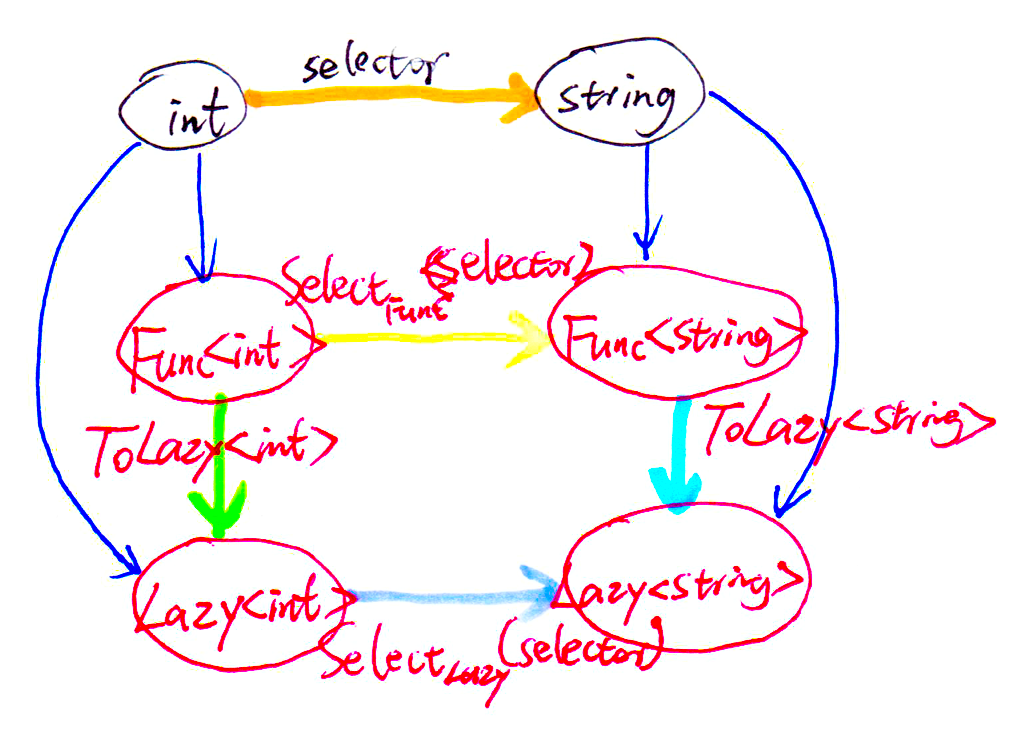
flowchart TD
subgraph C[" "]
X{"int"}
Y{"string"}
X-->|"selector"|Y
end
subgraph D[" "]
FX{"Func<int>"}
FY{"Func<string>"}
FX-->|"Select<sub>Func</sub>(selector)"|FY
end
subgraph E[" "]
GX{"Lazy<int>"}
GY{"Lazy<string>"}
GX-->|"Select<sub>Lazy</sub>(selector)"|GY
end
X-->|"Func<>"|FX
Y-->|"Func<>"|FY
X-->|"Lazy<>"|GX
Y-->|"Lazy<>"|GY
FX-->|"ToLazy<int>"|GX
FY-->|"ToLazy<int>"|GY
style C stroke:#666ff,stroke-width:0px
style D stroke:#ff6666,stroke-width:0px
style E stroke:#66ff66,stroke-width:0px
style X stroke:#6666ff
style Y stroke:#6666ff
style FX stroke:#ff6666
style FY stroke:#ff6666
style GX stroke:#66ff66
style GY stroke:#66ff66The following example is a simple naturality square that commutes for ToLazy<>:
internal static void Naturality(){ Func<int, string> selector = int32 => Math.Sqrt(int32).ToString("0.00");
// Naturality square: // ToFunc<string>.o(LazyExtensions.Select(selector)) == FuncExtensions.Select(selector).o(ToFunc<int>) Func<Func<string>, Lazy<string>> funcStringToLazyString = ToLazy<string>; Func<Func<int>, Func<string>> funcInt32ToFuncString = FuncExtensions.Select(selector); Func<Func<int>, Lazy<string>> leftComposition = funcStringToLazyString.o(funcInt32ToFuncString); Func<Lazy<int>, Lazy<string>> lazyInt32ToLazyString = LazyExtensions.Select(selector); Func<Func<int>, Lazy<int>> funcInt32ToLazyInt32 = ToLazy<int>; Func<Func<int>, Lazy<string>> rightComposition = lazyInt32ToLazyString.o(funcInt32ToLazyInt32);
Func<int> funcInt32 = () => 2; Lazy<string> lazyString = leftComposition(funcInt32); lazyString.Value.WriteLine(); // 1.41 lazyString = rightComposition(funcInt32); lazyString.Value.WriteLine(); // 1.41}And the following are a few more examples of natural transformations:
// ToFunc: Lazy<T> -> Func<T>public static Func<T> ToFunc<T>(this Lazy<T> lazy) => () => lazy.Value;
// ToEnumerable: Func<T> -> IEnumerable<T>public static IEnumerable<T> ToEnumerable<T>(this Func<T> function){ yield return function();}
// ToEnumerable: Lazy<T> -> IEnumerable<T>public static IEnumerable<T> ToEnumerable<T>(this Lazy<T> lazy){ yield return lazy.Value;}Functor Category
Now there are functors, and mappings between functors, which are natural transformations. Naturally, they lead to category of functors. Given 2 categories C and D, there is a functor category, denoted DC:
- Its objects ob(DC) are the functors from category C to D .
- Its morphisms hom(DC) are the natural transformations between those functors.
- The composition of natural transformations α: F ⇒ G and β: G ⇒ H, is natural transformations (β ∘ α): F ⇒ H.
- The identity natural transformation maps each functor to itself
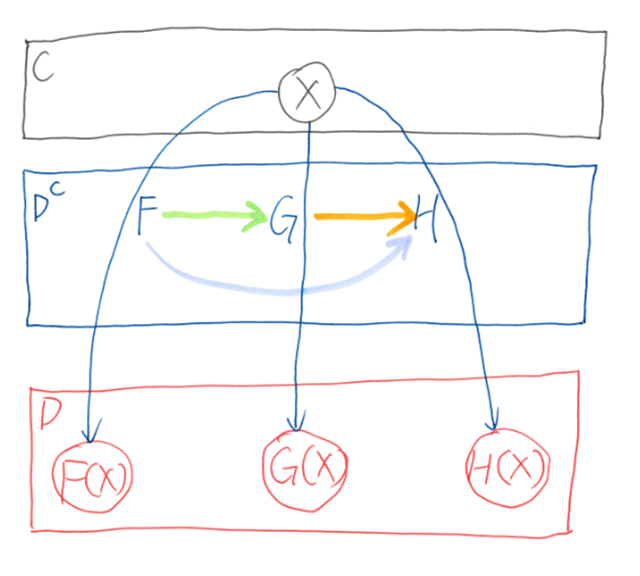
flowchart TD
    subgraph C["C"]
        X{"X"}
    end

    subgraph D["D<sup>C</sup>"]
        F{"F"}
        G{"G"}
        H{"H"}

        F-->G
        G-->H
        F-->H
    end

    subgraph E["D"]
        FX{"F(X)"}
        GX{"G(X)"}
        HX{"H(X)"}
    end

    X---F-->FX
    X---G-->GX
    X---H-->HX

    style C stroke:#6666ff
    style D stroke:#ff6666
    style E stroke:#66ff66

    style X stroke:#6666ff

    style F stroke:#ff6666
    style G stroke:#ff6666
    style H stroke:#ff6666

    style FX stroke:#66ff66
    style GX stroke:#66ff66
    style HX stroke:#66ff66
Regarding the category laws:
- Associativity law: As fore mentioned, natural transformation’s components are morphisms in D, so natural transformation composition in DC can be viewed as morphism composition in D: . Natural transformations’ composition in is associative, since all component morphisms’ composition in D is associative
- Identity law: similarly, identity natural transform’s components are the id morphisms in D. Identity natural transform satisfy identity law, since all its components satisfy identity law.
Here is an example of natural transformations composition:
// ToFunc: Lazy<T> -> Func<T>public static Func<T> ToFunc<T>(this Lazy<T> lazy) => () => lazy.Value;#endif
// ToOptional: Func<T> -> Optional<T>public static Optional<T> ToOptional<T>(this Func<T> function) => new Optional<T>(() => (true, function()));
// ToOptional: Lazy<T> -> Optional<T>public static Optional<T> ToOptional<T>(this Lazy<T> lazy) => // new Func<Func<T>, Optional<T>>(ToOptional).o(new Func<Lazy<T>, Func<T>>(ToFunc))(lazy); lazy.ToFunc().ToOptional();}Endofunctor category
Given category C, there is a endofunctors category, denoted , or End(C), where the objects are the endofunctors from category C to C itself, and the morphisms are the natural transformations between those endofunctors.
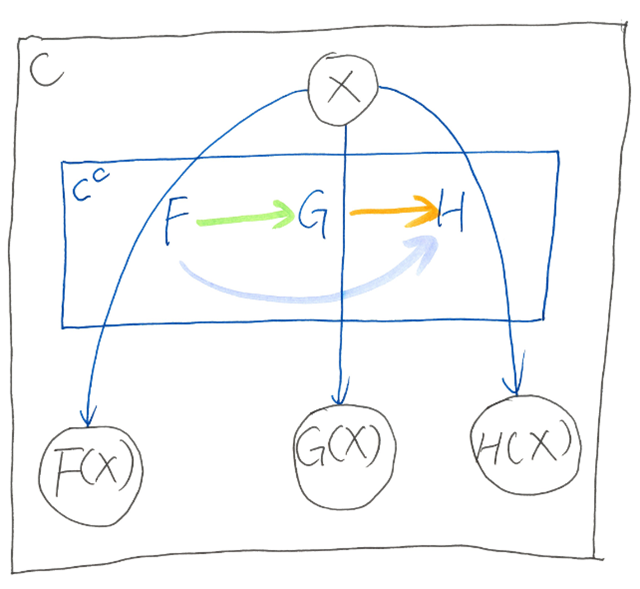
flowchart TD
    subgraph C["C"]
        X{"X"}

        subgraph D["D<sup>C</sup>"]
            F{"F"}
            G{"G"}
            H{"H"}

            F-->G
            G-->H
            F-->H
        end

        subgraph E[" "]
            FX{"F(X)"}
            GX{"G(X)"}
            HX{"H(X)"}
        end

        X---F-->FX
        X---G-->GX
        X---H-->HX
    end

    style C stroke:#6666ff
    style D stroke:#ff6666
    style E stroke:#66ff66,stroke-width:0px

    style X stroke:#6666ff
    style F stroke:#ff6666
    style G stroke:#ff6666
    style H stroke:#ff6666
    style FX stroke:#66ff66
    style GX stroke:#66ff66
    style HX stroke:#66ff66
All the functors in C# are endofunctors from DotNet category to DotNet. They are the objects of endofunctor category or End(DotNet).